John Bowlby - From Psychoanalysis to Ethology by van der Horst Frank C. P. Kagan Jerome
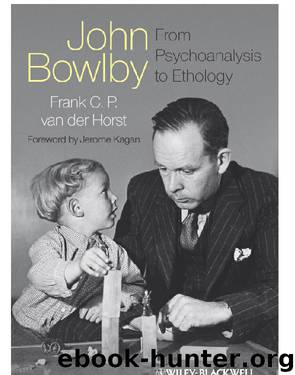
Author:van der Horst, Frank C. P., Kagan, Jerome
Language: eng
Format: mobi, epub
Publisher: John Wiley & Sons
Published: 2010-11-03T22:00:00+00:00
Hinde’s Early Career and Bowlby’s Subsequent Influence
Robert Hinde’s academic career started in 1950, when he pursued a Ph.D. with Niko Tinbergen after the latter had made the move from Leiden to Oxford (Kruuk, 2003; Tinbergen, 1991). In practice though, Hinde was supervised by David Lack. Hinde’s (1952) Ph.D. thesis was an observational study of the Great Tit. Hinde described it as “a behavioral observation study in which I just wandered around the Wytham Wood with a notebook and a pencil and a pair of field glasses” (Van der Horst, Van der Veer, and Van IJzendoorn, 2007, p. 327). After completing his Ph.D., Hinde returned to Cambridge, where he had earlier earned his Master’s degree, and was asked to supervise the ornithological field station in Madingley. The field station was set up in 1952 by W.H. Thorpe, who had also considered Konrad Lorenz for the job, but the latter had turned down the offer. In all modesty, Hinde commented that “various people turned down [Thorpe’s] offer of the job and eventually he came down the list to me and so I was in on the start of that enterprise” (Van der Horst, Van der Veer, and Van IJzendoorn, p. 327). During this period at the field station, Hinde worked on bird behavior and he “happened to do a study on imprinting” (Van der Horst, Van der Veer, and Van IJzendoorn, 2007, p. 327) which is how Lorenz became interested in his work and subsequently pointed Bowlby to its existence (see earlier in the chapter).
After attending the meetings at the Tavistock clinic for a couple of years, Hinde shifted his attention from studying bird behavior to research in monkeys. This move was clearly at the instigation of Bowlby, without whom Hinde “wouldn’t have set up a rhesus colony to study separation” (Van der Horst, Van der Veer, and Van IJzendoorn, 2007, p. 326) in 1959. According to Hinde, Bowlby “had a very big influence on me, it influenced the subsequent course of my research” (Van der Horst, Van der Veer, and Van IJzendoorn, 2007, p. 327). Bowlby supported Hinde in acquiring enough funds to set up the rhesus colony. Clearly, it was Bowlby’s hope that Hinde would “obtain experimental evidence that maternal separation could have long-term effects” (Hinde, 2005, p. 8). This becomes apparent from Hinde’s application for a grant from the Mental Health Research Fund as well. The proposal (dated autumn 1958) consisted of two projects concerned with (a) “certain types of abnormal or apparently irrelevant behavior which are related to situations of stress” and (b) “the formation of the early mother-offspring relation, which is so important for mental health” (AMWL: PP/BOW/B.3/18). Especially the second project is relevant here, since it was evidently designed to support Bowlby’s ideas. In his application, Hinde stated that:
Although the importance of an adequate mother-child relationship is now recognised by psychiatrists, clinicians and pediatricians, the precise manner in which it is built up still is uncertain. In particular, the relative importance of tangible rewards, such as
Download
John Bowlby - From Psychoanalysis to Ethology by van der Horst Frank C. P. Kagan Jerome.epub
This site does not store any files on its server. We only index and link to content provided by other sites. Please contact the content providers to delete copyright contents if any and email us, we'll remove relevant links or contents immediately.
Rewire Your Anxious Brain by Catherine M. Pittman(18734)
Talking to Strangers by Malcolm Gladwell(13474)
The Art of Thinking Clearly by Rolf Dobelli(10637)
Mindhunter: Inside the FBI's Elite Serial Crime Unit by John E. Douglas & Mark Olshaker(9447)
Becoming Supernatural by Dr. Joe Dispenza(8302)
Change Your Questions, Change Your Life by Marilee Adams(7873)
Nudge - Improving Decisions about Health, Wealth, and Happiness by Thaler Sunstein(7774)
The Road Less Traveled by M. Scott Peck(7683)
The Lost Art of Listening by Michael P. Nichols(7568)
Mastermind: How to Think Like Sherlock Holmes by Maria Konnikova(7459)
Enlightenment Now: The Case for Reason, Science, Humanism, and Progress by Steven Pinker(7369)
Win Bigly by Scott Adams(7285)
The Way of Zen by Alan W. Watts(6689)
Daring Greatly by Brene Brown(6575)
Big Magic: Creative Living Beyond Fear by Elizabeth Gilbert(5850)
Grit by Angela Duckworth(5686)
Ego Is the Enemy by Ryan Holiday(5562)
The Laws of Human Nature by Robert Greene(5350)
Men In Love by Nancy Friday(5325)
